We investigate the slow dynamics in the suspension of the magnetic colloidal
chains confined in a thin film [1].
We consider the model system confined in a thin film with thickness  which contains
  magnetic colloidal chains dispersed in an equilibrium solvent with a viscosity magnetic colloidal chains dispersed in an equilibrium solvent with a viscosity  at temperature at temperature  . The external magnetic field . The external magnetic field  is applied perpendicular to the film. is applied perpendicular to the film.
Fig. 1:
A Snapshot of magnetic colloidal chains confined in thin film.
|
|
The position of the center of mass for  -th magnetic colloidal chain -th magnetic colloidal chain  is described by the Langevin-like equation on the time scale is described by the Langevin-like equation on the time scale 
where  is the relaxation time for the colloidal chain to diffuse a distance of average radius is the relaxation time for the colloidal chain to diffuse a distance of average radius  for the colloidal chains and for the colloidal chains and
 an average diffusion coefficient of a single chain. an average diffusion coefficient of a single chain.
 is a Gaussian, Markov random velocity with zero mean and is a Gaussian, Markov random velocity with zero mean and  a dipole force between particle a dipole force between particle  in the -th chain and particle in the -th chain and particle  in the in the  -th chain.
Here the -th colloidal chain consists of -th chain.
Here the -th colloidal chain consists of  magnetic colloidal particles and the colloidal particle in -th colloidal chain has the susceptibility magnetic colloidal particles and the colloidal particle in -th colloidal chain has the susceptibility  , mass , mass  , and radius , and radius  . Let . Let  denote the average number of the colloidal particles which form one colloidal chain.
The area fraction of the colloidal chains denote the average number of the colloidal particles which form one colloidal chain.
The area fraction of the colloidal chains  is given by is given by  where the total area of the film is where the total area of the film is  . .
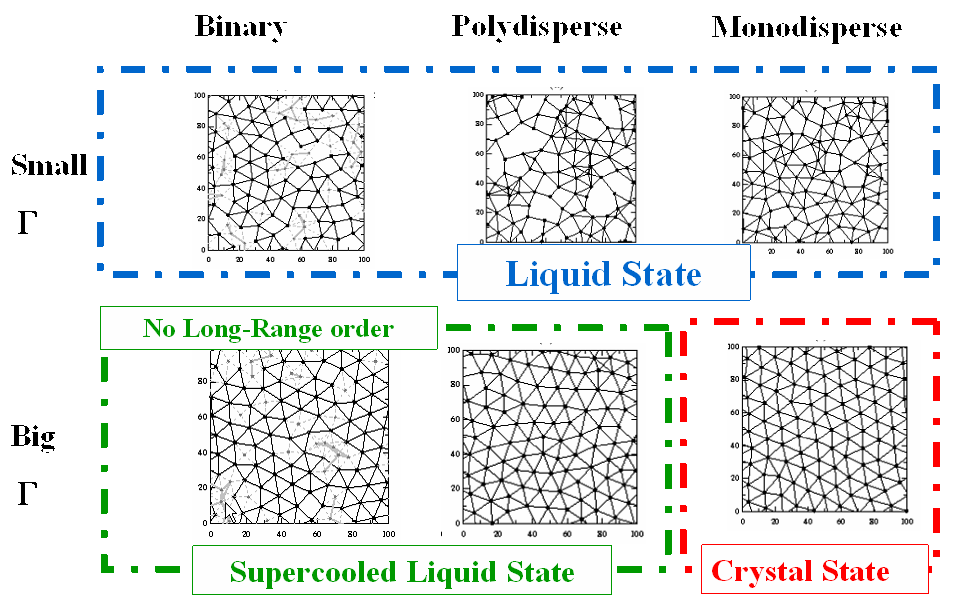
Figure 2 shows a two-dimensional projection of the magnetic colloidal chains
on xy plane for (a) monodisperse system, (b) binary systems, and (c) polydisperse
system. Here the dimensionless parameter  is the indicator of the intensity of the dipole potential energy [2]. is the indicator of the intensity of the dipole potential energy [2].
Fig. 2:
A projection of magnetic colloidal chains on xy plane for binary system, polydisperse system, and monodisperse system.
|
|
Figure 3 shows the mean square displacement of chains given by  for (a) the binary colloidal suspensions with number ratio of the small colloidal chains to all chains for (a) the binary colloidal suspensions with number ratio of the small colloidal chains to all chains  , where we set the parameters of the particles the same as those in ref.[2] and the small (or big) colloidal chain consists of all identical small
(or big) particles, and for (b) the 15 % polydisperse colloidal suspensions.
On both suspensions of colloidal chains confined in the film with different
thickness, the crystallization does not occur as the intensity of the external
field is increases, where no long-range order exists at the strong external
field. The only difference in those systems with different thickness is
that the average long-time diffusion coefficient of all chains confined
in the thin film is smaller than that in the thick film at a constant external
field. The reason is that many-body interactions between the long chains
confined in the thick film is much stronger than those in the thin film.
We also find that the dynamic behaviour of the systems with the same average
long-time diffusion coefficient is described by one master curve, even
though those confined in the film with different thickness contain both
of binary colloidal chains with any number ratio and polydisperse systems.
It is one example for similarities in diversely different glass-forming
systems [3]. , where we set the parameters of the particles the same as those in ref.[2] and the small (or big) colloidal chain consists of all identical small
(or big) particles, and for (b) the 15 % polydisperse colloidal suspensions.
On both suspensions of colloidal chains confined in the film with different
thickness, the crystallization does not occur as the intensity of the external
field is increases, where no long-range order exists at the strong external
field. The only difference in those systems with different thickness is
that the average long-time diffusion coefficient of all chains confined
in the thin film is smaller than that in the thick film at a constant external
field. The reason is that many-body interactions between the long chains
confined in the thick film is much stronger than those in the thin film.
We also find that the dynamic behaviour of the systems with the same average
long-time diffusion coefficient is described by one master curve, even
though those confined in the film with different thickness contain both
of binary colloidal chains with any number ratio and polydisperse systems.
It is one example for similarities in diversely different glass-forming
systems [3].
Fig 3:
A log-log plot of the mean-square
displacement vs time. (a) monolayer binary colloidal particles with  for for  , and , and  and for (b)
  15 %
polydisperse colloidal chains for 15 %
polydisperse colloidal chains for  and and  from top to bottom at from top to bottom at  . Dashed lines indicates the simulation results on liquid state and solid lines supercooled liquid state. . Dashed lines indicates the simulation results on liquid state and solid lines supercooled liquid state.
(a) (b)
![\includegraphics[height=0.485\linewidth]{figa-1-binary-M2.eps}](research-interest_e_4/img40.png)
![\includegraphics[height=0.485\linewidth]{figa-1-poly-M2.eps}](research-interest_e_4/img41.png)
|
|
References
| 1 |
Y. Terada, thesis (Tohoku University) (2007). |
| 2 |
H. König,
R. Hund,
K. Zahn, and
G. Maret,
Euro. Phys. J. E 18,
287 (2005). |
| 3 |
M. Tokuyama, Physica A (2007) "Similarities in diversely different glass-forming systems" Available online 10 January 2007. |
|
![\includegraphics[height=0.45\linewidth]{chain-poly.ps}](research-interest_e_4/img13.png)