
 Laboratory
 Research
 Joint research
Global Collaborative Research and Education Center for Integrated Flow Science (IFS-GCORE)
Advanced Integrated Flow Science Laboratory (CPC Lab)

Distinguished Professor S. Mani Sarathy



Energy conversion using chemical fuels remains essential for power generation, transportation, and industrial applications due to its high energy density and operational flexibility. Achieving carbon neutrality, however, requires a transition from fossil fuels to low- and zero-carbon energy carriers. The CPC Lab is connected by a shared purpose and culture focused on solving global energy challenges.
The CPC Lab’s research focuses on understanding and designing next-generation energy systems by integrating chemical kinetics, combustion science, and energy systems engineering. Through experiments and numerical simulations, we investigate the fundamental reaction processes of emerging fuels such as hydrogen, ammonia, and sustainable aviation fuels (SAF), with particular attention to ignition, flame stability, and emissions formation.
In parallel, we evaluate energy systems from a broader perspective using techno-economic analysis (TEA) and life cycle assessment (LCA), ensuring environmental and practical feasibility. By combining fundamental science with system-level analysis, we aim to establish a platform for the design and deployment of efficient, low-emission energy technologies.
Ammonia and Low-Carbon Fuel Combustion
Ammonia and hydrogen are promising energy carriers due to their potential for carbon-free energy conversion and compatibility with existing infrastructure. However, ammonia exhibits low reactivity and introduces challenges related to NOₓ formation and toxic intermediate species.
We investigate the fundamental reaction pathways governing ammonia and ammonia–hydrocarbon combustion using experiments and detailed kinetic modeling. Particular focus is placed on ignition, flame stabilization, pollutant formation, and interactions with conventional fuels. These studies support the development of combustion strategies that achieve high efficiency while minimizing harmful emissions.
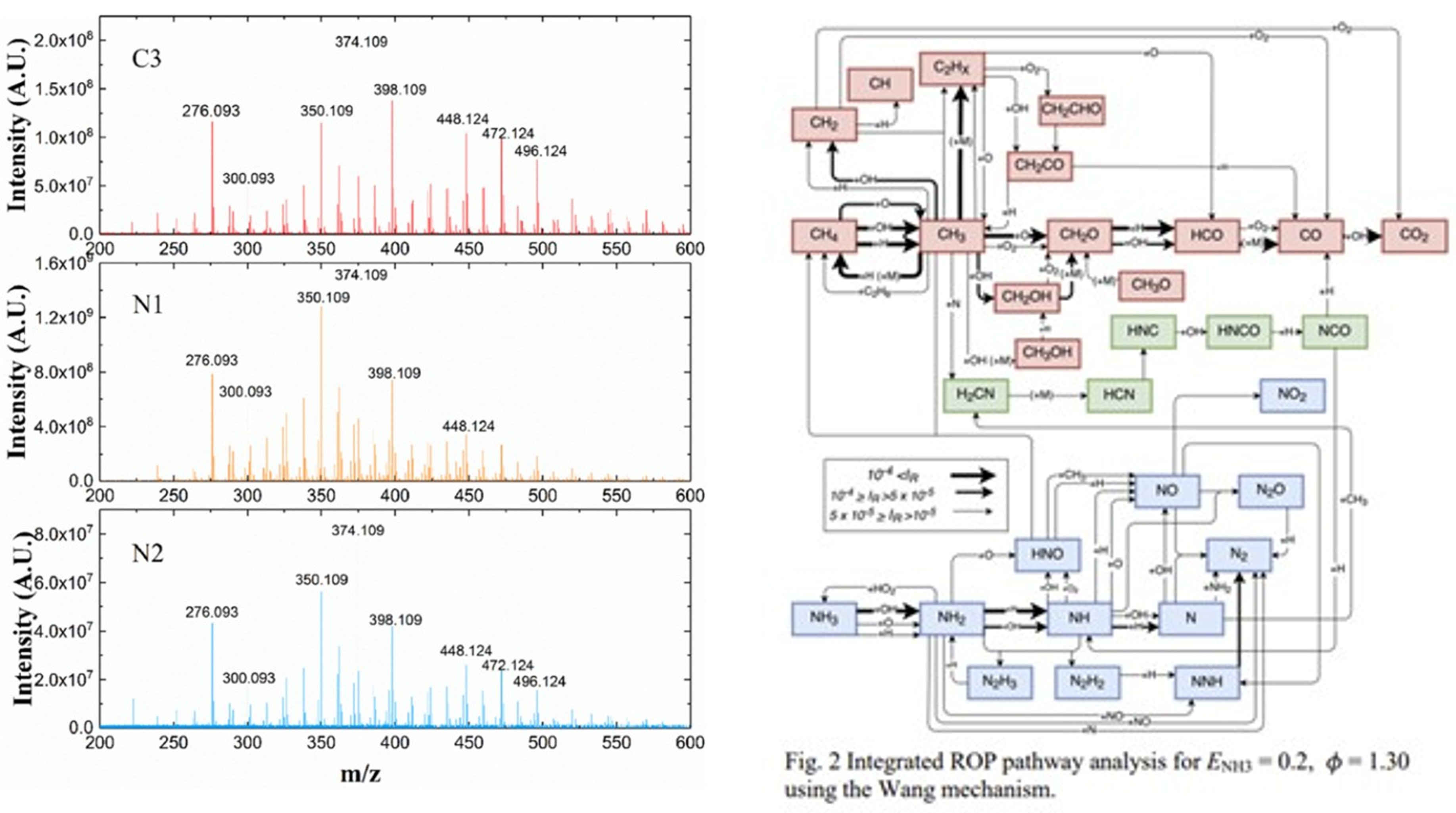 Experimental and kinetic-modeling analysis of ammonia combustion chemistry, showing key nitrogen reaction pathways and intermediate species governing ignition and NOₓ formation.
References: C. Shao et al, Combust. Flame, 2022; M. Kovaleva, Proc. 61st Symp. (Japanese) Combust., Tokyo, 2023.
Sustainable Aviation Fuel (SAF) Combustion
Sustainable aviation fuels are essential for decarbonizing aviation, yet their diverse feedstocks and compositions introduce uncertainty in combustion behavior and emissions. Non-CO2 effects, including soot formation and contrail impacts, are particularly important.
We develop detailed reaction models and data-driven frameworks to predict SAF combustion characteristics and emissions. These models are integrated with computational fluid dynamics simulations to evaluate fuel–engine interactions and guide the design of cleaner aviation systems.
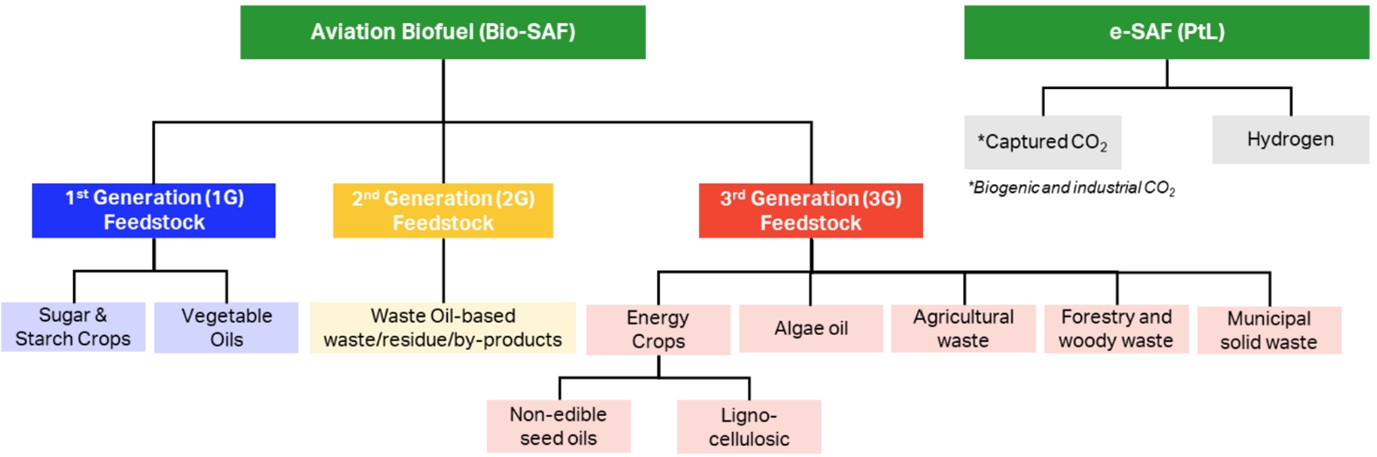 SAF Feedstock classification.
Reference: https://www.iata.org/globalassets/iata/publications/sustainability/global-feedstock-assessment-for-saf-production-outlook-to-2050.pdf (accessed March 5, 2026).
Advanced Energy Systems and Supply Chains
The deployment of renewable fuels depends not only on production technologies but also on supply chain design, infrastructure, and policy constraints. We develop integrated frameworks combining techno-economic analysis, life cycle assessment, and system optimization to evaluate fuel pathways under realistic conditions.
This work supports the design of resilient, cost-effective energy systems tailored to specific regions and applications.
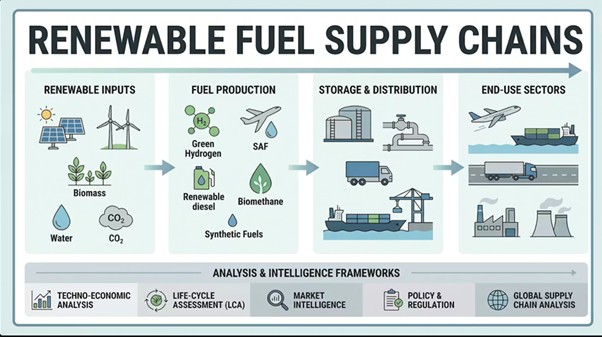 Integrated renewable fuel supply chain framework linking fuel production, storage, distribution, infrastructure, and end-use sectors through techno-economic, environmental, and systems-level analysis.
Immersion Cooling of Microchips
The rapid growth of artificial intelligence and high-performance computing is driving increasing demand for large-scale data centers with high power consumption and heat generation. Modern graphic processing units (GPUs) operate at extremely high power densities, creating significant thermal management challenges that exceed the capabilities of conventional air and indirect liquid cooling technologies.
In this context, direct immersion cooling, in which electronic components are submerged in a dielectric liquid, is emerging as a promising thermal management approach. Our research investigates the fundamental thermal transport phenomena governing immersion cooling through advanced optical diagnostics and numerical modeling. Using phase-shift interferometry imaging, we experimentally visualize and quantify heat transfer characteristics under various operating conditions. The effects of liquid properties, flow behavior, and power density on cooling performance are systematically evaluated to support the development of efficient and reliable next-generation cooling technologies for high-performance computing systems.
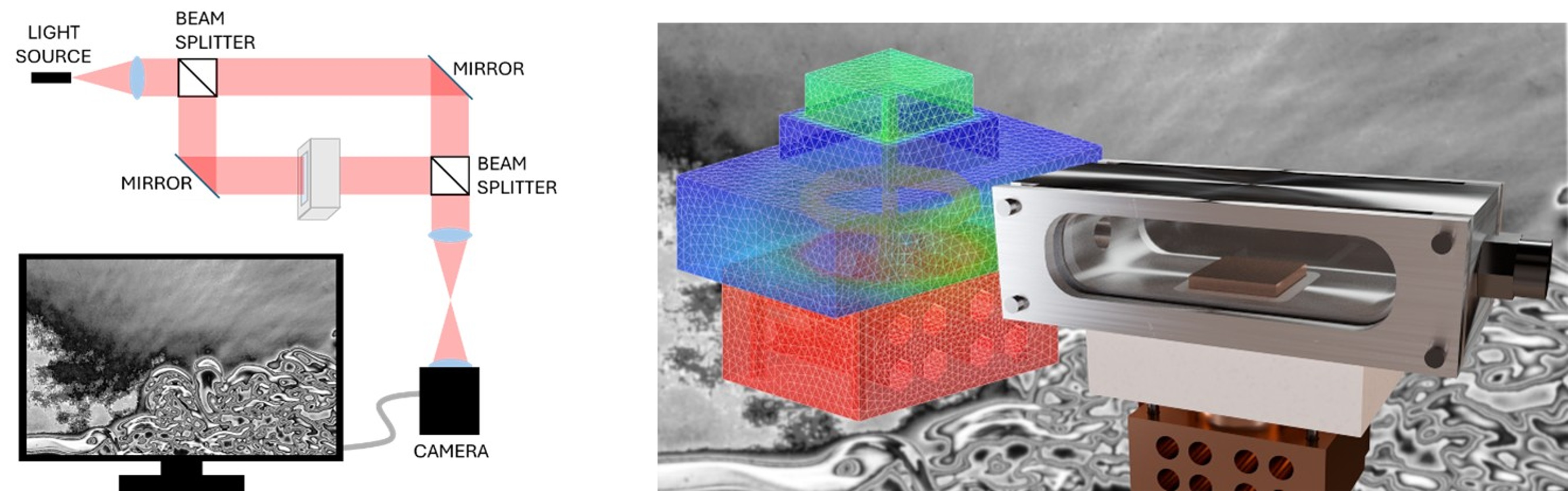 Optical diagnostics and interferometry imaging of direct immersion cooling, used to investigate thermal transport and heat transfer behavior in high-power electronic cooling systems.